


“Every single step you take is just one more piece of the puzzle.” — Chris Hadfield, Astronaut
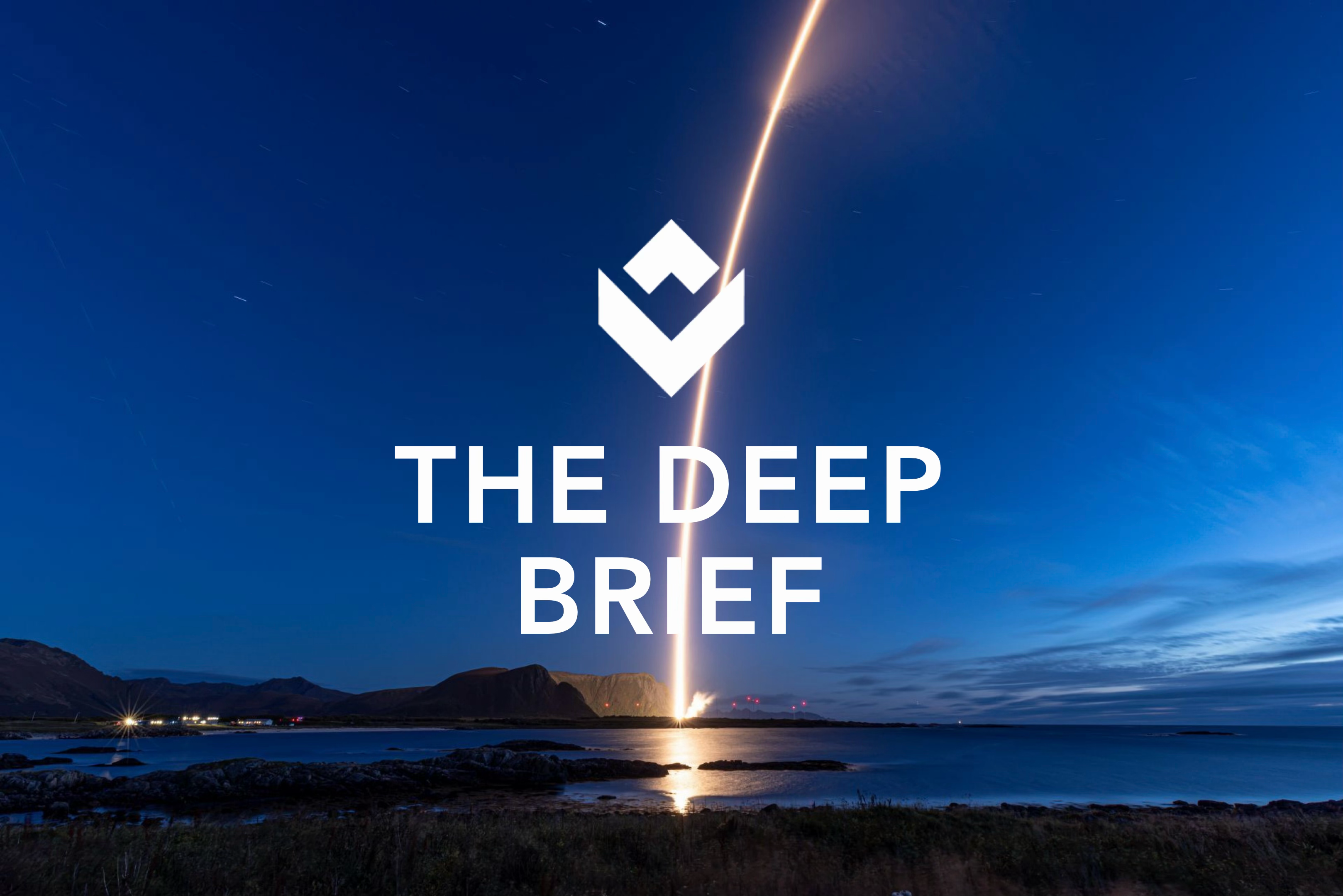
For European space, one rather important piece fell into place on Saturday, 5 September. Our portfolio company, Isar Aerospace, managed to launch its Spectrum rocket from Andøya, Norway, and put it into orbit, on only its second attempt.
There are many reasons for us at Vsquared Ventures to celebrate. But one stands above the rest: for the first time, a European commercial launch company has successfully reached orbit from continental Europe.
We first backed Isar Aerospace at the very beginning, in 2018. Eight years later, they’re in orbit. Even after a few days, it’s difficult not to marvel at the magnitude of what just happened. Everything worked end to end, from launch to Max q (the point of maximum aerodynamic pressure), to stage separation, to second-stage ignition, to orbital insertion and, finally, to payload deployment. On that same night, mere hours after the launch, some customers were already receiving signals from their satellites deployed in orbit by Spectrum.
The past 18 months have provided a lot of growth for Isar. The first test flight, in March 2025, was terminated about 30 seconds after liftoff and the vehicle fell into the sea. But this was actually not a loss, as the launch provided the company vital data and insights, providing solid support for the next iteration. Then, when the company was ready to launch again, multiple delays were encountered due to a valve issue, the weather, and range safety from boats passing by. The launch had to be delayed several times to provide the best conditions for success—and it finally paid off.
That full success happened on only the second flight, which is a prowess in the industry. Vehicles 3-7 are already in production in a 40,000 m2 factory near Munich that has been designed to assemble 40 vehicles per year. Isar Aerospace has now entered a ramp-up phase, with its order book filling up fast. This is a very important milestone for the company, its backers and the whole of Europe as the space race is about to intensify.
Why space matters
Space is an industry like no other. It is not only highly strategic, as it commands the ability to deploy critical military and economic infrastructure across communications, Earth observation, navigation, climate and defense, it also provides access to humanity’s last frontier, with the power to unlock access to vast, untapped resources and to inspire innovators across the globe. Considering this, some, such as McKinsey and the World Economic Forum estimate that the global space economy could reach $1.8 trillion by 2035, up from $630 billion in 2023.
The problem is that when it comes to space, we are facing incredible capacity constraints. The global launch industry is dominated by US providers, above all SpaceX. China is not a realistic launch provider for many Western governments and companies, particularly for sensitive national-security missions. Ariane 6, the main European player, has a substantial backlog, particularly from large constellation customers, and its capacity is not a simple substitute for flexible dedicated launches in the small and medium satellite market.
In addition, SpaceX is already shifting capacity away from Falcon 9 and towards Starship. Customers have reportedly been turned away from Falcon 9 launches beyond 2028, while SpaceX says it expects Falcon 9 launch activity to decline as Starship enters service. As a result, medium-lift supply is tightening exactly as demand surges. The world needs to launch more numerous and diverse satellites into space, but the capacity to do so in a sustainable manner is shrinking by the day.
The main reason for this is the increasing concentration of the market. The limited supply makes it so that only large players, with lots of satellites to launch, can secure access, and even they are put on multi-year waiting lists. Another problem is quasi-dependency on the US, which can be an issue in certain circumstances: launching from US territory brings the mission within a US regulatory framework, including FAA payload review and, where relevant, US export-control and national-security requirements. Some nations may not want this in the current geopolitical context. Finally, there’s the rigidity of what’s on offer: if the only way to launch satellites into space is to piggyback on a large rocket’s launch, you are not the one choosing your date, SpaceX does.
The ITAR asymmetry
If there’s so much demand, why can’t the US, specifically SpaceX, add capacity then? The reason lies in one word: ITAR. Under the strict export restrictions that apply in the US space industry, US space companies are more or less restricted to employing US persons (citizens and permanent residents). Indeed, sharing technical data with foreign nationals is effectively an export event requiring a license from the State Department. For companies handling ITAR-controlled technology, access to controlled technical data can be restricted to authorized personnel, creating significant compliance and staffing constraints. In addition, ITAR can make exporting US-origin launch hardware, technology and technical know-how substantially more difficult, particularly when foreign persons and foreign production are involved. As a result, the main thing they can sell to foreign customers is… rides.
From a US perspective, this constrains both talent and international expansion. Isar Aerospace, by contrast, has built an international workforce of more than 400 people from over 50 nations, and has greater flexibility to export launch vehicles, infrastructure and the broader launch stack to customers seeking sovereign launch capabilities.
What Isar Aerospace is already doing
This is exactly the direction Isar is headed from a commercial perspective. In July 2026, it signed a contract with Canada’s Maritime Launch Services to deliver a dedicated Spectrum launch complex at Spaceport Nova Scotia. Isar is establishing a Canadian subsidiary, and the first launch is targeted for as early as 2028. The deal is closely linked to TKMS‘s Canadian submarine program, with the launch capability forming part of the broader industrial cooperation package offered to Canada.
If it works with Canada, it can work with many other nations across the world. Isar can’t launch from its home country of Germany, whose geography doesn’t lend itself well to such activities, but it can launch from Norway, Canada and many other countries. Subject to export controls, licensing, safety and range requirements, Isar’s relatively compact system could potentially be deployed at multiple national launch sites. The host nation provides the site and the regulatory framework, and even the final assembly can happen locally, as it will in Canada.
The system is even more scalable due to the relatively smaller size of Isar’s Spectrum, which requires simpler ground infrastructure than SpaceX’s large rockets and therefore makes it more feasible to replicate launch sites in multiple countries. The portability of Isar-made infrastructure is a key part of what makes the export model work.
Sovereignty as a service
Beyond the specific case of Isar, this precedent already shows us what could be a winning strategic positioning for Europe in the space industry: not building the largest rockets to launch the heaviest payloads, but rather providing any friendly nation with sovereignty as a service. The market is quite large, as a substantial number of countries have suitable geography for some form of orbital launch, but lack the infrastructure, regulation or industrial base to exploit it. What they need is the freedom to act on their geographic ability to launch.
Indeed, most of these nations clearly have the need to launch satellites, yet many of them are reluctant to depend on a single provider. What Europe, specifically a company such as Isar, can provide them is the tools of their freedom: launch technology, deployed locally, assembled and operated on the buyer’s end. And beyond Isar Aerospace, a whole ecosystem of European commercial players, among them our portfolio company The Exploration Company, can embrace that model and provide space sovereignty as a service across the globe.
None of this, by the way, should be interpreted as a move against America and its own, more advanced ecosystem. Instead, it should be read as a way to massively expand the market for all, in two concentric circles: the inner circle corresponds to US capacity, which is powerful but restricted and necessarily focused on serving the US government and commercial customers under US terms; then the outer circle can include European providers servicing the rest of the allied world in a more flexible and scalable way. All in all, Europe’s contribution is to expand the total Western-aligned launch capacity without diluting US control over its own tech.
Opening up the market
This, by the way, is another reason why Isar’s success is such welcome news for the European space industry: we’re in desperate need of diversification in launch capacity. Isar’s Spectrum is designed for payloads of up to 1,000 kg to low Earth orbit, putting it well below the heavy-lift class dominated by Falcon 9 and Starship—Falcon 9 can carry more than an order of magnitude more mass to LEO than Spectrum, while Starship V3 is designed for 100 tonnes. That is all to say, the good news for the market is that we’re entering a phase of segmentation.
This is desperately needed by customers. Satellites have shrunk and diversified faster than the launch industry has adapted. Isar is built for a payload class that already exists but is underserved by the market: because a dedicated Falcon 9 currently costs commercial customers about $74m before mission-specific additions, for many smaller operators, rideshare has been the cheapest and most readily available option—in which those operators have to give up control of date, orbit and timeline. As an example, another of our portfolio companies, constellr, plans to launch a small constellation of satellites in the 150-300 kg range. A dedicated Isar launch could deploy half of that constellation in one go, on the customer’s schedule.
If we make the analogy with ground transportation, Falcon is a bus, and Isar is a taxi. Out of necessity, a bus only goes to the bus station on the bus schedule. By contrast, a taxi can open routes the bus doesn’t serve. Overall, both can obviously coexist because more vehicles at more price points means more satellites can get built, more constellations can get funded, and more downstream businesses become viable. Segmentation expands the total market and makes the impressive figures brought forward by the likes of the BryceTech and McKinsey more realistic.
Conclusion: Behold the space industry’s picks and shovels
The door Isar Aerospace just opened for the European space industry leads to vast opportunities. The launch sector, after all, is only a small fraction of the total value of the space economy, with much larger value waiting to be realized downstream, in communications, Earth observation, navigation, climate and defense. Yet launch remains the prerequisite for all of it. No launch access means no participation in any downstream space business. Launch is the ultimate barrier to entry.
Isar Aerospace’s success is primarily that of Daniel, Joseph and their incredible team. But by proving commercial launch access for the whole of Europe and beyond, they’re turning many nations around the world into potential participants in the extraordinary value-creation opportunity that is the space industry. The next step is to scale it, and we look forward to being on Isar’s side as they tackle this new challenge.

The Exploration Company raised a $450M Series C, the largest ever by a European space company, co-led by Bessemer Venture Partners, Atomico and the Scaleup Europe Fund (managed by EQT). Existing backers Balderton, Plural, Cherry and Red River West also participated. The capital funds development of the Nyx cargo capsule toward an ISS docking mission and accelerates Storm, a reusable high-thrust engine. Total funding since the 2021 founding now stands at roughly $680 million. LINK
Arlequin AI closed a €28M Series A, co-led by Redalpine and OTB Ventures, with Bpifrance’s Defense Innovation Fund also participating. We increased our stake, as did 10x Founders; Xavier Niel joined the round. The investor base is entirely European. The capital scales Arlequin’s proprietary architecture based on topological neural networks, a non-LLM approach to analyzing large, interconnected datasets, with applications in defense, fraud detection, cybersecurity and AI safety. LINK
Ground A emerged from stealth with a €9.1M pre-seed led by us, with Quantum Systems investing alongside GRIF, Robin Capital, ABACON, Leblon Capital and OVNI Capital. Founded in January, the company built the GA 1000—a portable, laser-based counter-drone system combining radar, optical sensors, computer vision and a directed-energy effector—and reached the testing and validation phase within months. They’re now entering series production in Germany. LINK
Cylib acquired a discharging, disassembly and mechanical pre-processing facility in Bavaria, with annual capacity of up to 10,000 metric tons of end-of-life EV batteries. The site is the first node in Cylib’s feedstock network, supplying black mass to its hydrometallurgical recycling plant under construction in Dormagen. Operations are expected to begin in Q4, with full capacity targeted by end of 2027. LINK

The AI Debt Binge Is Endangering the Economy (Robin Wigglesworth, NYT). The author argues that AI infrastructure has become a credit story: hyperscalers have issued $445B in debt so far in 2026, with off-balance-sheet lease commitments and purchase obligations adding another $3Tn, making the better historical parallel not dot-com but the railway bond manias of the 1870s. Worth reading for anyone sizing downstream risk to deep tech if the AI capital cycle turns. LINK
Armed With $10 Billion, Sequoia’s Leaders Plan Its New Era (Mascarenhas, Torrence & Ludlow, Bloomberg). A look inside Sequoia’s generational transition under Alfred Lin and Pat Grady, who are concentrating the firm’s $10B around AI—including a multi-billion-dollar position in Anthropic after years of passing on it. Worth reading as a signal of how much US VC is consolidating around a single thesis, and what that concentration means for capital allocation everywhere else. LINK
The Elephant Behind Ukraine’s Drone Revolution (Oleksiy Tatarenko, NEIS Center). Tatarenko argues that the real Ukrainian breakthrough was not drones themselves but the industrial innovation system behind them: a demand-driven marketplace where combat units signal needs in real time, producers compete to fill them, and battlefield data feeds back into design cycles measured in weeks. The lessons for peacetime industrial policy—that demand, not R&D funding, drives scale-up, and that institutional design matters more than any single technology—map directly onto Europe’s clean-tech and defense-industrial challenges. LINK
On the German Mittelstand (Kieran Velasquez). The author spent months touring factories across Germany and traces a line from medieval blacksmith guilds through the Gründerzeit to today’s Hidden Champions, arguing that the Mittelstand’s moat is not any single technology but the fusion of tacit knowledge, generational workforce development, and an ownership structure that eliminates the principal-agent problem. A rich companion piece to any thesis on European deep tech industrialization. LINK
The Ground Truth Institute (Denisa Lepadatu & Ed Boyden). The authors argue that biology lacks the equivalent of quantum mechanics or the periodic table—a complete map of its building blocks—and that without one, drug discovery remains an astronomically expensive lottery. They propose a new institutional structure that ties early-stage tool-building (high risk, no revenue) to the lower-risk therapies it eventually enables so that the financial upside of cured diseases funds the foundational science that makes curing them possible. A blueprint for how deep tech institutions might close the gap between discovery and deployment. LINK
Data at the Edge (Rebecca Kaden, USV). Kaden argues that the classic software data flywheel—collect, improve, collect more—is now forming in the physical world, as cheaper sensors, cheaper hardware, and models that can digest messy unstructured inputs make previously dark datasets accessible for the first time. The investment implications track closely to the deep tech stack: foundation models for robot dexterity, ocean sensor networks, edge silicon, and the energy infrastructure underneath it all. An echo to our own data dividend thesis. LINK
