

The Case for More, and for Deep Tech in Particular
The German Venture & Growth Playbook makes the case for more institutional capital. We add the deep tech case.

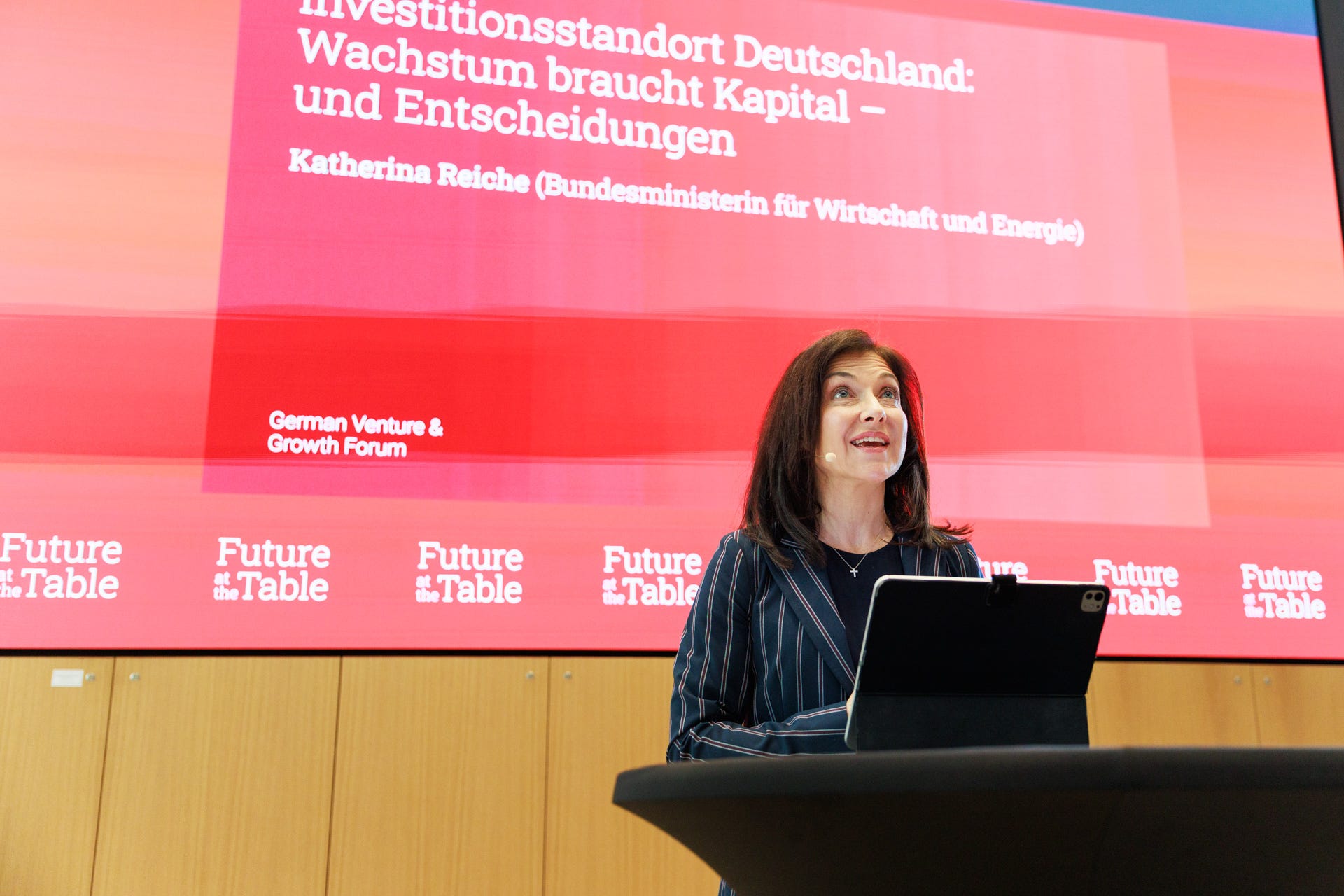
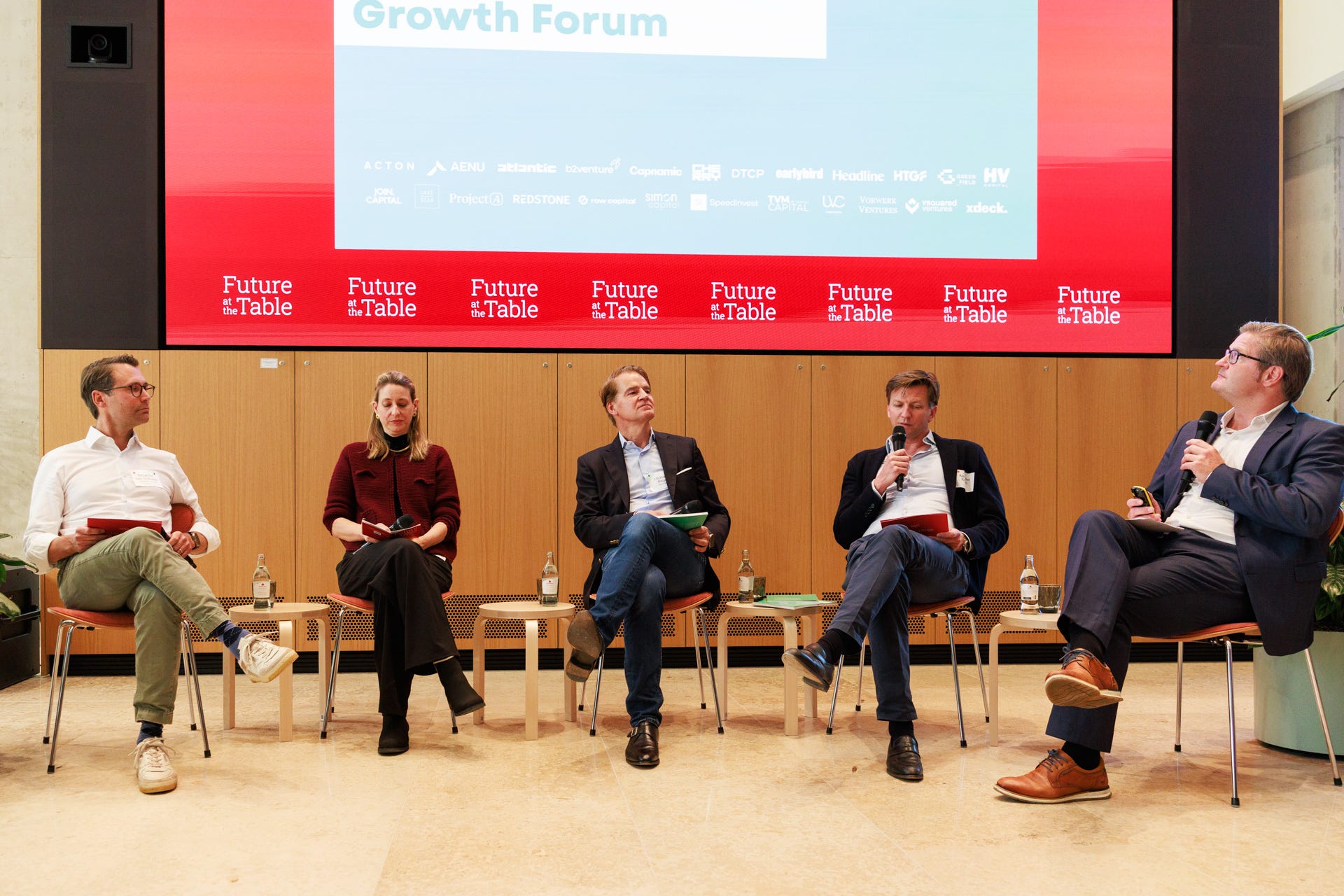
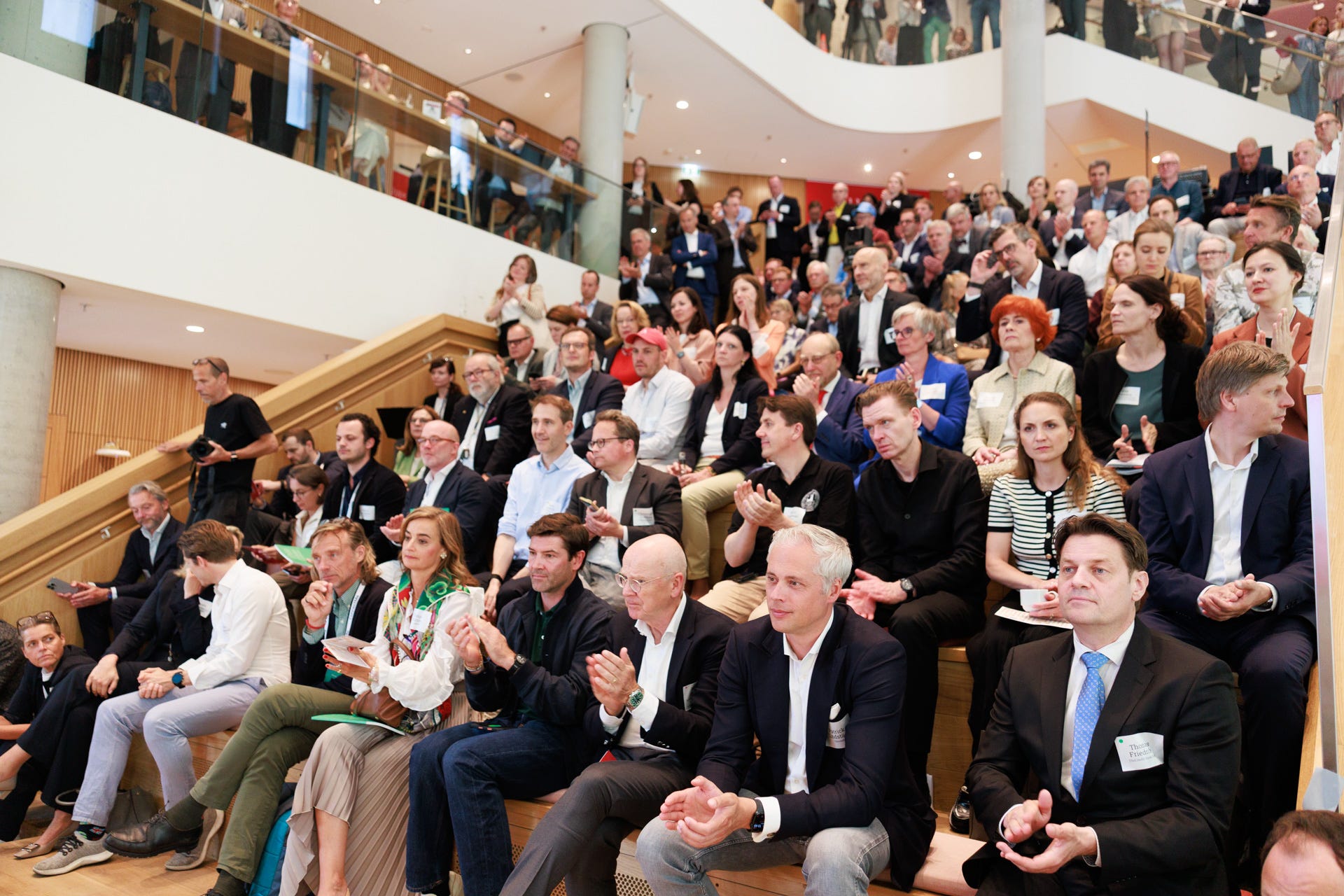
This week in Berlin, the German Venture & Growth Forum brought institutional investors, German venture funds and policymakers together around one question: how to mobilise venture and growth capital for Germany. Together with 23 other funds, Vsquared released the German Venture & Growth Playbook, developed by investment practitioners and addressed to insurers, pension funds and foundations. I had the honor of sitting on one of the panels and contributing to what we believe is an important discussion from both a German and a European perspective.
What does the Playbook argue? Quite simply, that German and European institutions hold far too little venture and growth capital. We believe that institutions should allocate more, for two reasons at once: the returns in this particular asset class are higher than what they earn today, and the capital lifts the innovation power, and so the future output, of the country that supplies it. Conversely, if the capital keeps failing to arrive, Germany and Europe will not convert today’s economic strength into tomorrow’s technology, and risk ceding both. Other nations have spent years raising institutional allocation to venture and growth, and have built newer, more resilient industries on the back of it. We should follow them.
The cost of staying out
The Forum’s headline finding is an allocation gap. Quite surprisingly, many German institutions hold nothing at all in venture capital, sometimes nothing across private markets, while the foreign investors they are measured against hold a steady share. For instance, Harvard’s endowment runs a quarter of its assets in venture and growth. As for large Australian, Canadian, Swedish and US pension funds, they hold between 1 and 5% of their assets in venture capital and earn net returns near or above 10%.
German pension providers, by contrast, returned close to zero in real terms over the five years to 2023, among the lowest in the OECD. In other words, avoiding the asset class has not made them better off on any front: not on returns, which trail allocating peers, and not on volatility, which a low-correlation holding lowers rather than raises.
Indeed, the reasons usually given for staying out do not survive the data:
Over the past 20 years European venture and growth funds have matched their North American peers and global buyout funds from a performance perspective, at roughly 14 to 18% net IRR.
Because the asset class correlates weakly with public markets, even a small slice contributes to raising a portfolio’s return and lowering its volatility at the same time. The risk of losing money across the whole position falls away with diversification: for any given institution, allocating capital to three to five funds, or 100 to 150 companies, makes a write-down of the total very unlikely.
Finally, as is often the case, regulation is not the wall it is assumed to be. Specifically, the German rules cap unlisted holdings well above the 1 to 5% an investor would actually commit, and Solvency II sets no maximum at all.
It has been done before
There is a precedent worth recalling, and it is not a story about America so much as a sequence any market can follow. We in Europe can draw inspiration from the history of American venture capital, which was unlocked by three things in turn:
First, early returns proved the model. Companies such as Apple, Genentech and Intel showed across the 1970s that venture could produce results far beyond public markets, and drew the attention of larger allocators.
Second came the regulator’s blessing and the government’s support. The 1978 cut in capital gains tax, followed by the Department of Labor’s 1979 clarification of ERISA’s “prudent man” rule, opened the door to pension fund investment in venture capital. The change followed years of lobbying by industry leaders including David Morgenthaler and Lionel Pincus. New commitments rose from tens of millions of dollars in the late 1970s to more than $5 billion by 1983, and within a decade pension funds supplied close to half of all venture capital.
Third came a theory. The Yale endowment model, described at length in David Swensen’s landmark book Pioneering Portfolio Management, gave institutions a reasoned basis for placing a small, deliberate slice in venture, and turned an ad hoc, who-knows-whom practice into standard allocation. A theory does this work because it gives a market a common language. That’s because, as the late Intel CEO Andy Grove once put it, a theory has the power to give “a common language and a common way to frame a problem for reaching agreement on a counter-intuitive course of action”.
And so, this is what is needed for institutions to finally allocate more to venture and growth capital funds in Germany and Europe: (i) early returns to start the engine, (ii) the regulator’s blessing to remove the obstacles, and finally (iii) a theory to align the market and enable compounding.
Germany has two of the three
Germany already holds the first two: the returns are already proven, at 14 to 18% IRR, and the regulator already permits institutional allocation through the Anlageverordnung (AnlV) set of regulations and the European Solvency II.
So the missing leg is the third one, the theory, and our Playbook is positioned to supply it: Germany’s equivalent of the moment Swensen’s model created, the common language that lets a board or an investment committee approve, with confidence, an allocation their caution would otherwise resist.
The theory matters at the level of policy as well. Capital pushed into private markets by mandate, with no theory to guide it, is financial repression. Capital guided by a sound playbook is innovation policy. The Playbook is what separates the two, and it is designed as a tool for policymakers as much as capital allocators.

Why deep tech in particular
Within the asset class, deep tech is an exceptionally good bet for European capital. Our continent has the science, the industrial base to build on it, and, now, the demand to pull it through.
First, the science and the talent. Europe holds some of the best research in the world, in its technical universities and institutes and in a deep pool of scientific and engineering talent. Deep tech begins with a hard technical edge, and Europe produces that edge as well as anywhere.
Second, the industrial base. Germany above all has long roots in high-end manufacturing for complex, demanding markets, from cars and machinery to chemicals and precision engineering. The hard part of deep tech is the move from discovery to product at scale, which is where the first wave stumbled. A continent that already knows how to build complex hardware to exacting standards is better placed to clear that bar, and early mastery of those standards becomes an advantage a better-funded latecomer cannot simply buy.
Third, the demand, and it is arriving now. Governments are spending at scale, with defense budgets rising across Europe, large space programmes, and a push to rebuild semiconductor capacity at home. That spending is a buyer willing to pay for reliability and sovereign supply before the open market is ready, which does the work a Series B does in software. It proves demand, takes the risk out of heavy capital spending, and opens the door to non-dilutive capital from banks, credit and infrastructure funds.
Put together, the three do something a software bet rarely does: the capital compounds twice. A company funded past a certain stage grows its supply chain nearby, which makes it hard to copy, and the returns then accrue to the investor and to the domestic economy at once, in jobs, infrastructure and process knowledge kept on the continent.
Fair enough, the first wave of European deep tech was hard, and parts of it failed. Several battery makers raised billions and went under, the most prominent collapsing into the largest industrial bankruptcy in modern Swedish history. But from an investor’s perspective, diversification makes the loss of any one company survivable, and a failed wave leaves trained engineers and hard-won process knowledge that a better-sequenced effort can build on.

The sums are trivial
The usual objection to allocating more to venture and growth capital is a macro one: capital prefers dollars and the US market, and at the largest rounds it increasingly goes there.
The American pull is very real, and it can be felt every day in the industry. But the scale of what Germany needs is not that large. Specifically, the shortfall in venture and growth runs to about €15 billion, a small fraction of what German savers already place abroad each year. Closing it is a question of direction, not capacity. After all, Europe is a net saver, and Germany more so than most. The problem is that the savings currently sit in bonds and property earning little. What Germany has lacked is the channel to move them.
Of course, today’s Germany cannot be compared to the US on all terms. For instance, where the US in 1979 only had to free pension money already sitting in funded plans, Germany holds comparatively little in funded, capital-based pensions, the natural long-term backer of venture capital in the US. Fortunately, that is now changing, as the government signals a shift toward funded private and occupational pensions playing a far larger role, which builds, over time, the patient institutional capital base that backs future technology through targeted allocation. Redirecting even a small share keeps the value European companies create, and its control, on this side of the Atlantic, and earns the institutions that do so more than they make today.
The case for the panel
The report we unveiled this week is right that Europe should allocate more, for the returns and for the country both. We at Vsquared would add that deep tech is where one euro allocated does the most work, because a demanding regulatory environment, skyrocketing defense demand and the need to build domestic supply chains turn the allocation into a durable advantage rather than a one-off return.
Germany already has the returns and the regulatory tailwinds. The missing piece is the theory, and the German Venture & Growth Playbook can be it. Supply the common language, as the Yale model once did, and the capital will follow. We at Vsquared intend to do our part on both counts: backing the founders who are building Europe’s deep tech, and helping supply the common language that brings institutional capital to them.

Neura Robotics raised a Series C of up to $1.4 billion at a valuation of around $7 billion, with Tether, Qualcomm, Amazon and Nvidia, alongside Bosch, Schaeffler and the European Investment Bank. The capital funds its physical AI platform and humanoid production, with a target of millions of robots by 2030. LINK
Isar Aerospace signed a €270 million Series D, taking total funding to about €870 million, with new investors Island Green Capital and Molten Ventures joining existing backers HV Capital, Lakestar, UVC Partners and KfW Capital, and the NATO Innovation Fund. The capital scales serial production of the Spectrum launch vehicle and expands launch operations abroad, with defense now accounting for roughly 60% of demand. LINK
IQM began trading on Nasdaq after completing its merger with Real Asset Acquisition Corp, a special-purpose acquisition company, making it one of Europe's first listed quantum computing firms. The deal valued IQM at about $1.8 billion in pre-money equity and is expected to provide over $450 million in cash, including a roughly $134 million PIPE, to fund research, chip fabrication and commercial scaling. The company is also pursuing a secondary listing on Nasdaq Helsinki. LINK
Zama acquired TokenOps, a token lifecycle platform that has processed over $2 billion in distributions, to extend fully homomorphic encryption to confidential and compliant token distributions, vesting and airdrops for institutional issuers. The deal advances Zama’s aim of building a confidentiality layer for onchain finance. LINK
Vaeridion marked three milestones at the ILA Berlin Air Show: over 100 new letters of intent for its nine-seat all-electric Microliner from six customers, completion of the aircraft-level Preliminary Design Review, and the selection of General Atomics Aeronautical Systems (GA-ASI) as the first business partner for its battery technology. First flight remains targeted for mid-2028. LINK
The Exploration Company completed a drop test of its Nyx recovery system in the Mojave Desert, validating the transition from drogue to main parachutes ahead of a 2028 cargo test flight to low Earth orbit. The company also said in May that it is seeking to raise $200 million in an upcoming round. LINK

Capital Stack Parallax (Tangible). William Godfrey argues that hardtech founders raise equity well but never learn to tap the debt and credit markets that are 75 times larger, and that scaling physical assets means presenting the same company honestly to two audiences at once. Essential reading on the non-dilutive financing that deep tech deployment depends on. LINK
The “Boring” Industrial Shortage That’s About to Break Everything (Jay Martin). Jay Martin traces how a closed Strait of Hormuz would starve China of sulphur, cascading into chemical, then copper and cobalt, shortages worldwide, and argues that energy alone no longer makes an industrial economy. Regardless of what becomes of the situation in the Gulf, his case for hard assets and hard-tech clusters like Proto-Town speaks to the deep tech thesis. LINK
The Future of American Strategy: Balancing a Bigger China (CFR). Rush Doshi argues that the United States can no longer match China’s scale on its own and must build “allied scale”, pooling economic, technological and military capacity with partners including the EU. Worth reading for how European industrial policy, export controls and reindustrialisation fit into a wider contest with China. LINK
Research Is Not Engineering at a Slower Speed (Roberto Pieraccini, The Voice in the Machine). A veteran of Bell Labs, IBM Research and Google argues that research, R&D and product engineering are three different jobs with different success criteria, and that firms which lump them into one budget line underfund what matters and drive away their best people. A sharp lens for judging whether a deep tech team is doing real research or engineering dressed up as it. LINK
The Quantum Computing Revolution Is Closer Than You Think (FT). Michael Peel reports that major tech firms now bet quantum machines will outperform conventional ones by 2030, with stakes in drug discovery, finance and the cryptography that “Q-Day” could break, while sceptics doubt useful machines can be built at all. A measured read on a deep tech frontier now drawing serious capital. LINK
A Cell Is Not a Spreadsheet: Why “Virtual Cells” Are Still Mostly Hype (The Meringue Moment). Evgeny Kiner argues that the virtual cell pitch is mostly metaphor, since unlike the text behind LLMs or the structures behind AlphaFold, no complete multi-modal dataset of the cell exists, which makes data, not model design, the real constraint. A bracing check for anyone weighing AI-for-biology claims. LINK
